
Lorem ipsum dolor sit amet, consectetur adipiscing elit Lorem ipsum dolor sit amet, consectetur adipiscing elit
Latest news from Packaging Innovations & Empack
Global secondary packaging market set to hit $300 billion by 2030 as sustainability and e-commerce reshape industry, new report finds
Smithers, in partnership with Packaging Innovations & Empack 2026, reveals how rapid growth in online retail, paper-based innovations, and EU regulatory changes are transforming secondary and protective packaging.

The global market for secondary and protective packaging is projected to reach $300.7 billion by 2030, driven by the accelerating rise of e-commerce and intensifying focus on sustainability, according to a new report from Smithers, produced in association with Packaging Innovations & Empack 2026.
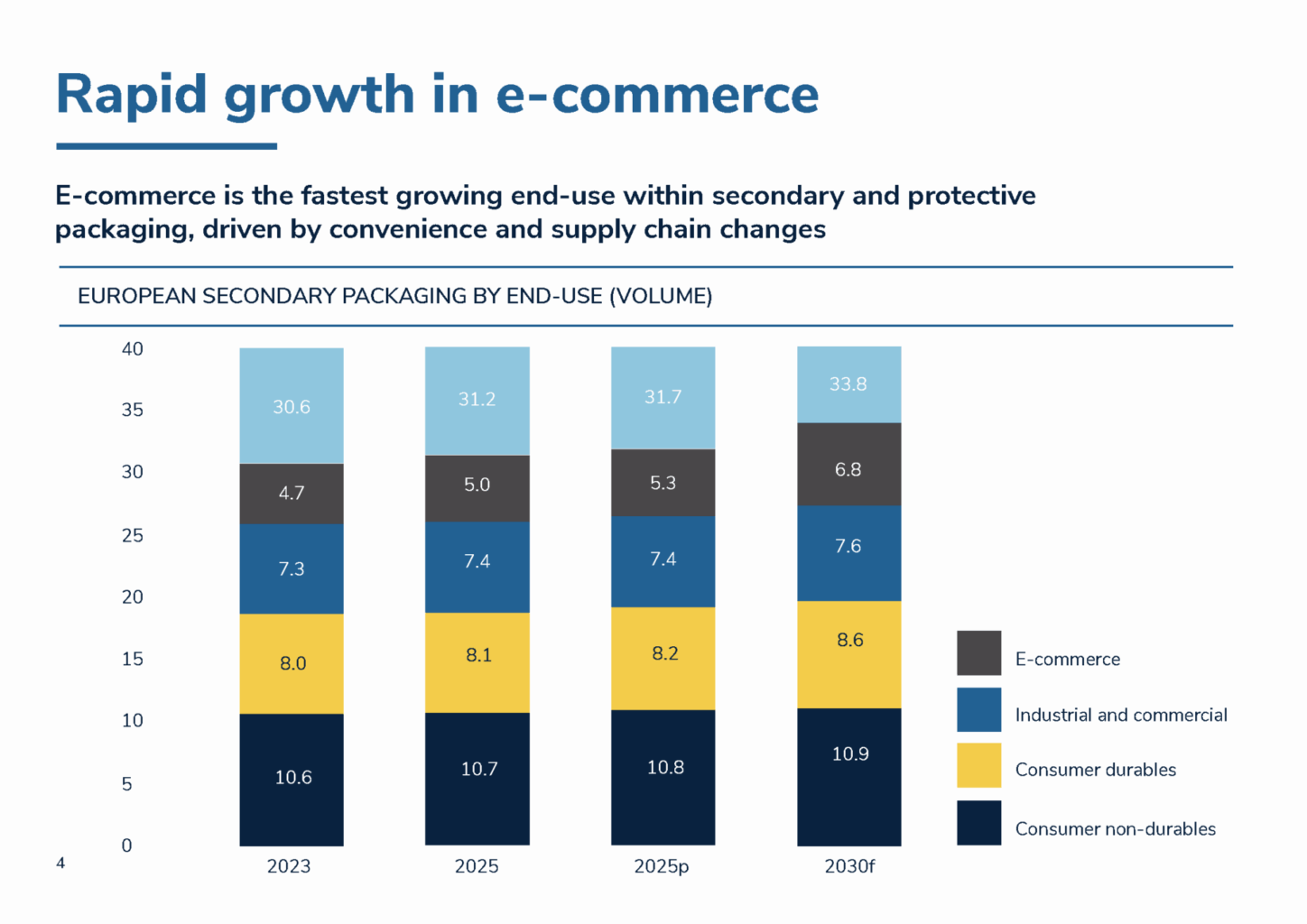
E-commerce is now the fastest-growing segment, surpassing consumer durables, non-durables, and industrial packaging. Smithers data shows that European e-commerce secondary packaging volumes will rise 45% by 2030, compared to just 10.5% growth across the overall market. In volume terms, e-commerce packaging is expected to increase from 4.7 million tonnes in 2023 to 6.8 million tonnes in 2030, versus 30.6 to 33.8 million tonnes for the total volume of secondary packaging. This shift means UK packaging demand is increasingly driven by warehouses, couriers, and returns rather than supermarket shelves, with implications for corrugated investment, pEPR fees, and recycling infrastructure.
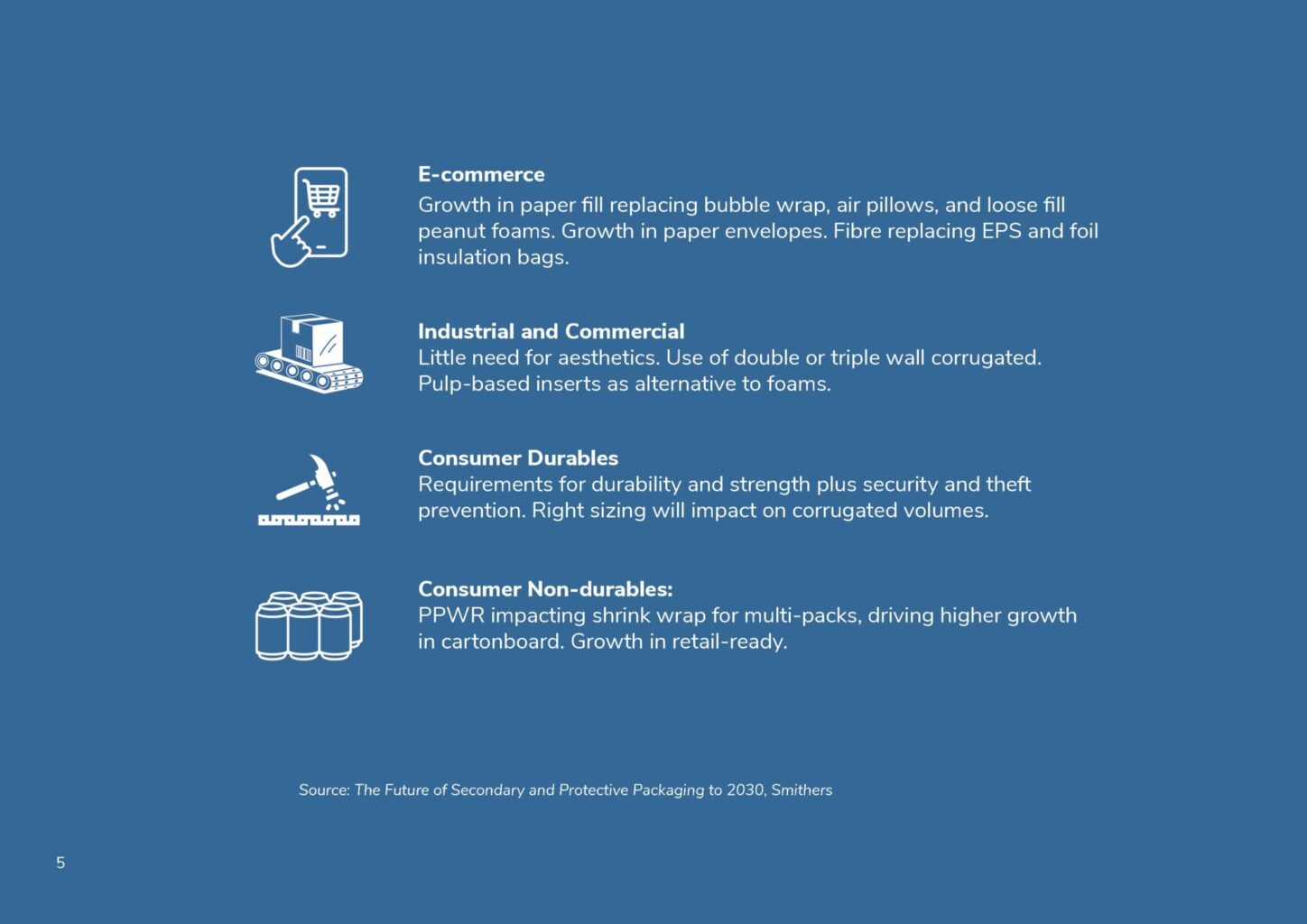
Paper-based solutions are overtaking plastic. Paper fill is forecast to grow at 3.9% CAGR in Western Europe to 2030, driven by automated dispensers in e-commerce fulfilment centres. Types of paper fill include twisted paper, Kraft paper void fill, and flexi-wrap moulded pulp, which are replacing bubble wrap, air pillows, and foam. In the UK, paper is increasingly chosen not just for sustainability but for operational reasons by avoiding the Plastic Packaging Tax, reducing EPR penalties, and suiting kerbside recycling.
Consumer expectations are clear: recyclability dominates. A 2025 McKinsey survey shows that 77% of UK consumers rate recyclability as extremely or very important, compared with just 41% for biobased materials. Consumers also value recycled content (62–66%) and compostability, but above all they want products that arrive undamaged and well-cushioned, even if that means slightly larger packaging. This highlights a growing tension: minimal packaging is not always the most sustainable solution. Returns and reshipping often create more emissions than slightly larger boxes or additional cushioning.
Regulatory pressures are reshaping the industry. A 2027 update to the EU’s Packaging and Packaging Waste Regulation (PPWR) will ban certain single-use plastics for multi-packs and set a 50% maximum empty-space limit for grouped and e-commerce packaging. While overall demand continues to grow, PPWR is expected to moderate growth in shrink wrap and traditional multi-pack plastics, accelerating adoption of cartonboard and paper fill. Empty air inside boxes is now a direct regulatory and financial risk, particularly for UK exporters and retailers selling into the EU.
Returnable packaging is emerging as an opportunity but comes with challenges. Cost, low return rates, durability, functionality, and logistics for cleaning and multiple deliveries remain significant barriers. Businesses exploring reusable packaging solutions must balance consumer convenience, product protection, and environmental impact to succeed.
“The global packaging industry is placing increasing emphasis on improving the environmental sustainability of its products as consumer expectations and regulatory requirements continue to intensify,” says Josh Brooks, Divisional Director – Packaging at Easyfairs. “Companies are working to reduce material use, adopt recyclable or renewable resources, and lessen overall environmental impact. However, these efforts must be balanced with the essential need for packaging to protect products throughout the supply chain.”
Brooks continues: “In Europe, EU member states are preparing to implement the PPWR over the next five years, aiming to meet the 2030 target for fully recyclable packaging. This regulatory push underscores the growing urgency for innovation that aligns environmental responsibility with reliable packaging performance.”
Corrugated remains the dominant material but faces pressure from right-sizing initiatives and returnable packaging alternatives. Automated systems capable of dynamically adjusting pack dimensions are increasingly sophisticated, helping businesses minimise material use while maintaining product protection and brand integrity.
Smithers will be exhibiting at Packaging Innovations & Empack 2026 on Stand Y160 and is a featured contributor within the event’s NEW Expert Trail for 2026, which highlights organisations shaping the future of the packaging industry through insight, evidence and expertise.
Packaging Innovations & Empack 2026, the UK’s largest packaging and processing event, will bring these trends to life on 11 & 12 February at NEC Birmingham. With over 450 suppliers, 7,400 industry professionals and 80 expert speakers exploring smart automation, AI, sustainable materials and next-generation machinery, this is where the future of packaging takes shape. Register now to be part of it & download the full report today.
Share this article

Lorem ipsum dolor sit amet, consectetur adipiscing elit Lorem ipsum dolor sit amet, consectetur adipiscing elit
Latest news from Packaging Innovations & Empack

Lorem ipsum dolor sit amet, consectetur adipiscing elit. Ut elit tellus, luctus nec ullamcorper mattis, pulvinar dapibus leo.